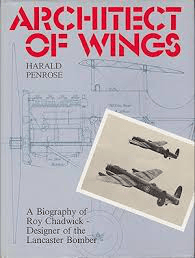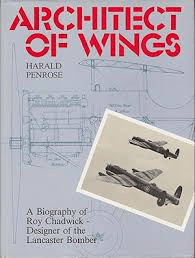
I had been looking for a biography of Roy Chadwick ( designer of the Lancaster bomber ) for a while and when I found this book in the Sywell Aviation Museum I was delighted since it is written by Harald Penrose. I have long admired Harald Penrose since not only was he a chief test pilot at Westland Aircraft ( between 1931 and 1953 ) but he was also a superb writer. I have previously read some of his other books such as ‘No Echo in the Sky’ and ‘British Aviation: Ominous Skies, 1935-1939’ and needless to say I was not disappointed.
The book extensively describes Roy Chadwick’s life and his early encounter with Alliott Verdon Roe for whom he wanted to work and their negotiation for a salary of 20 shillings a week. Aviation in the U.K. was in its early stages in 1911 and Penrose describes the early aircraft including the novel Type F Cabin monoplane. Development continued and eventually led to the famous Avro 504 and its derivatives. What I really like about this book is how Penrose places developments in the context of what else was happening in the industry and also in the geo-political environment of the time. Penrose lived through these times and was part of the industry so knew many of the aviation figures himself.
When Alliott Verdon Roe set up the Hamble facility, Roy Chadwick came down to Hampshire and after marrying his wife, Mary, lived in a flat at Peartree Green rented from the brother of Supermarine’s owner Hubert Scott-Paine! Chadwick’s career was inter-twined with that of Roy Dobson, who had also moved down from Manchester to Hamble, and was a manager there at the time. An interesting aspect of this time was Chadwick’s acquaintance with Sir Ernest Shackleton ( there was a family connection through his wife ) and the work on the Avro Baby which went on his 1922 ‘Quest Expedition’.
Avro were also involved with autogiros and Don Juan de la Cierva, resulting in Chadwick designing several autogiros. Now back in Manchester, Chadwick and Dobson were also working on larger twin engined aircraft such as the Avro 642 and a later RAF aircraft to become the Anson, together with trainer aircraft such as the Tutor.
Penrose describes the re-armament of the 1930s well and the role of others, such as Sir George Dowty, on the development of Avro aircraft which ultimately led to the Avro 679 Manchester. The problems with the Manchester, or rather its engines, are well known but it led to the four engined Manchester III or Lancaster. Roy Chadwick flew a lot on his aircraft and the book has a nice photograph of a flight he took on the Lancaster with test pilot Bill Thorn. Chadwick is also well known for how he managed to adapt the Lancaster to all sorts of different roles. The manufacturing team in Manchester, under the leadership of Dobson, were able to deliver the aircraft reaching a production level of 150 per month. Chadwick also developed the Lancaster into an interim transport aircraft, the York, and designed its successor, the Lincoln.
In the latter war years, attention turned to the civilian market with the interim Lancastrian before the Tudor came along. In 1945, Chadwick received a knighthood for ‘outstanding services to aviation’. The success of the Lincoln led to a Coastal Command long-range version, the Shackleton, and Chadwick told his wife “I hope to have them named ‘Shackleton’ in memory of your family’s relationship with Sir Ernest Shackleton and the happy pre-war day we spent with him aboard the Quest”.
The civilian airliner development of the Tudor was fraught with concern for Chadwick and unfortunately had a troubled development. He still found time to develop the initial concept of the Vulcan and Dobson told Chadwick “our good friend A.V. would claim that he inspired you! Do you remember him writing to me early in the war to say that the tail unit was an unnecessary appendage and if eliminated would save weight and so save cost? Our later master was a shrewd old bird”.
Sadly, Roy Chadwick was killed in 1947 in a disastrous crash of the Tudor 2 airliner along with Bill Thorn. The book describes the heart-breaking circumstances of the crash and its aftermath, the accident being due to the ailerons being connected in the wrong direction and not checked. Another Avro designer, Stuart Davies survived the crash and went on to develop the Vulcan design.
I thoroughly enjoyed reading this book which also placed Roy Chadwick’s work in the context of what else was going on at that time in the aviation industry. Although no longer in print, I have seen copies available on the abebooks website for example.
Publisher: Airlife Publishing
ISBN 0 906393 55 8
Published 1985
Book Review by
SHHAS member
James Mason
Architect of Wings
by
Harald Penrose