Cierva Autogyros
Words and photos by Tom Hiett
First published in 2006.
Juan de la Cierva was born in 1895, he became fascinated with aviation as a schoolboy. In 1918 he built a Bomber which crashed and so Cierva became interested in designing a craft which would fly at very low speeds and would not stall and kill the pilot.
Autorotation is best described as four wings flying into wind at the same time. The principle can be seen in a Sycamore seed which rotates whilst descending. Cierva applied the name Autogyro and registered the name. Only his Autogyros should carry the name.
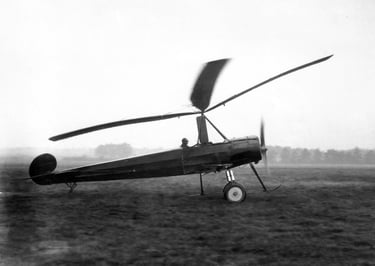
The first successful machine was the C4 first flown in Spain on January 22nd 1923. The rotor was started by rope which was wound round cleats fitted to each rotor blade and run out by a gang of strong young men. When the end of the rope came off opening the throttle bought a nice short run, or it didnt, anyway it usually worked. The C6 was demonstrated successfully in 1925 in Spain. Cierva was invited to demonstrate the machine at Farnborough in October 1925, the pilot was Frank T Courtney. Tests were carried out successfully and a top speed of 67 mph were found. Control could be carried out as low as 20 mph.
The Company Cierva Autogyro Ltd was set up on March 24th 1926. The works was at A V Roe Hamble and the man with the money was James G Wier of Glasgow. The rotor was built up on an S3 steel tube with ply ribs, the whole blade assembled in a concrete jig. The fuselages were built up on an Avro 504 base.
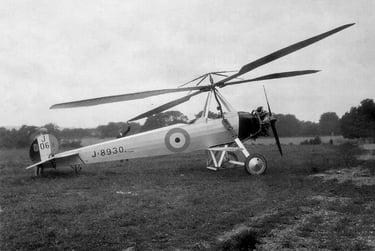
The C6D was demonstrated at Tempelhof, Berlin in September 1926 in front of Crown Prince Kaiser Wilhelm. Following success with the C6D orders came in for the C8 which was to fly in 1927. In 1927 there was a spectacular crash at Hamble and as a result Courtney left for the USA, test flying subsquently being carried out by Bert Hinkler and later Sqdn Ldr A H Rawson. C8L J 8930 was flown by Bert Hinkler, it made the first rotating wing cross country flight to Farnborough September 1927.
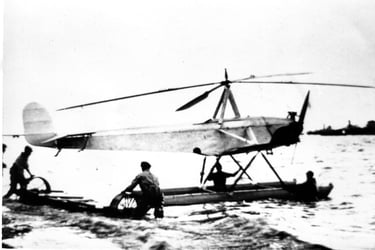
Success with C8L was followed by the C9, C10 and C11 and a new design the C17. Next was a useless machine the C12, an Avian fuselage on floats. It was tried at Hamble beach in April 1930, apart from giving the chaps a paddle it did nothing.
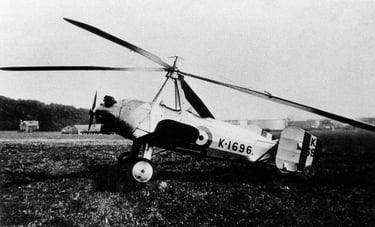
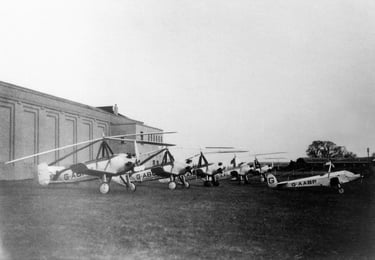
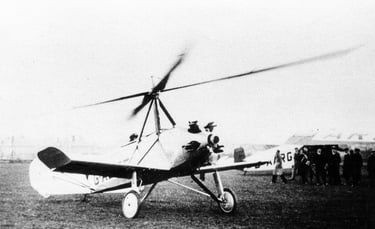
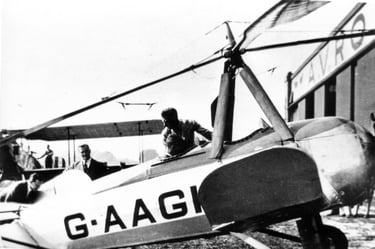
The C19 was next built, it had a deflecting tailpane tilted up to deflect the slipstream up into the rotor disc to give it a start. The C19 was built with a host of sub-types, Mk II, Mk III and IV were built and the Prince of Wales came down to inspect the machine, 28 were built. C19 was a much different machine, it had a short stubby fuselage, the Mk IVP had a handle in the cockpit for direct control of the rotor.
In 1932 Cierva moved to Hanworth and the ultimate design the C30 was built. It had a direct control rotor and a clutch start to the rotor. It had a short turned up tailplane and a long fixed fin/rudder. Power came from a 140hp Genet. The C30 had orders for 100 machines with some delivered to the British Army. It was a highly successful machine with lots being in use for traffic control, and lots of use in films etc. There was one in the RAF museum and several are flying in the USA.
In December 1936 Cierva was killed returning to Spain on a KLM DC2 which crashed on take off at Croydon, a great designer was gone. Cierva license was taken up by Wier (Glasgow), Avro (Manchester), Parnell, Westland, De Havilland and in the USA Pitcairn and Kellet, Focke Wulf in Germany & Kayaba company in Japan. In 1940, all available Cierva Autogyros and pilots went to Duxford where they later went to the RAF to form 529 Squadron based at aptly named Crazies Farm. They were used throughout the war for radar calibration. Whilst so engaged one was intercepted by two FW 190s, the pilot cleverly managed to avoid both and landed safely at Hawkings.
All autogyros were stood down in the UK in October 1945. The biggest user was Japan who used some of their 24 autogyros on submarine spotting during WWII. Cierva Autogryos began building helicopters at Cunliffe Owens factory at Eastleigh in 1943 only seven miles from Hamble where the first Autogyros were built.
Lots of autogyro ideas were used in helicopter design which is still ongoing today, eighty years on.
Tom Hiett
2006
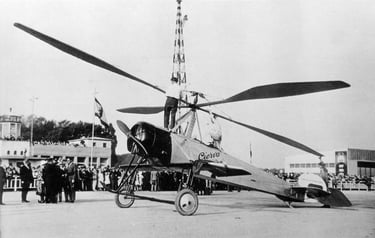
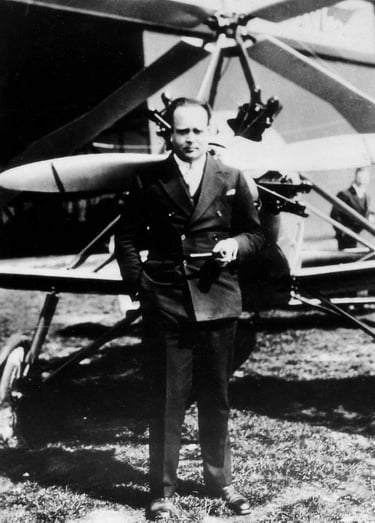
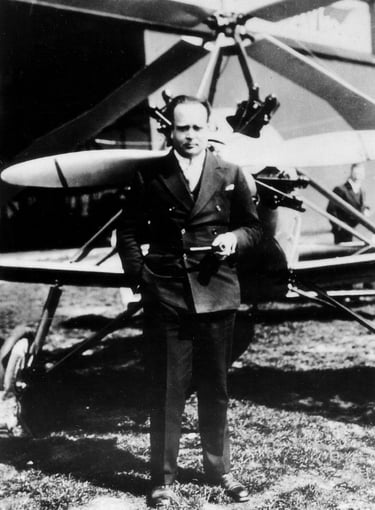
Juan Cierva with C19 at Hamble in 1929.
Cierva C6 testing at Farnborough in 1925.
First ever Hydroplane Cierva C12. Hamble 25 th April 1930.
Cierva C19 at Hamble with Prince of Wales alongside cockpit, 1929.
Cierva C6D demonstration before Kasier Wilheim at Tempelhof, Berlin 1926.
Cierva C19 Mk III K1696, Hamble 1926.
Cierva Autogyros set up for filming a newsreel, Hamble 1930.
Cierva C19 Mk III G-ABFZ during a demonstration at Hamble, 1928.
Cierva Autogyro CBL Mk I J8930, Hamble 1928.